


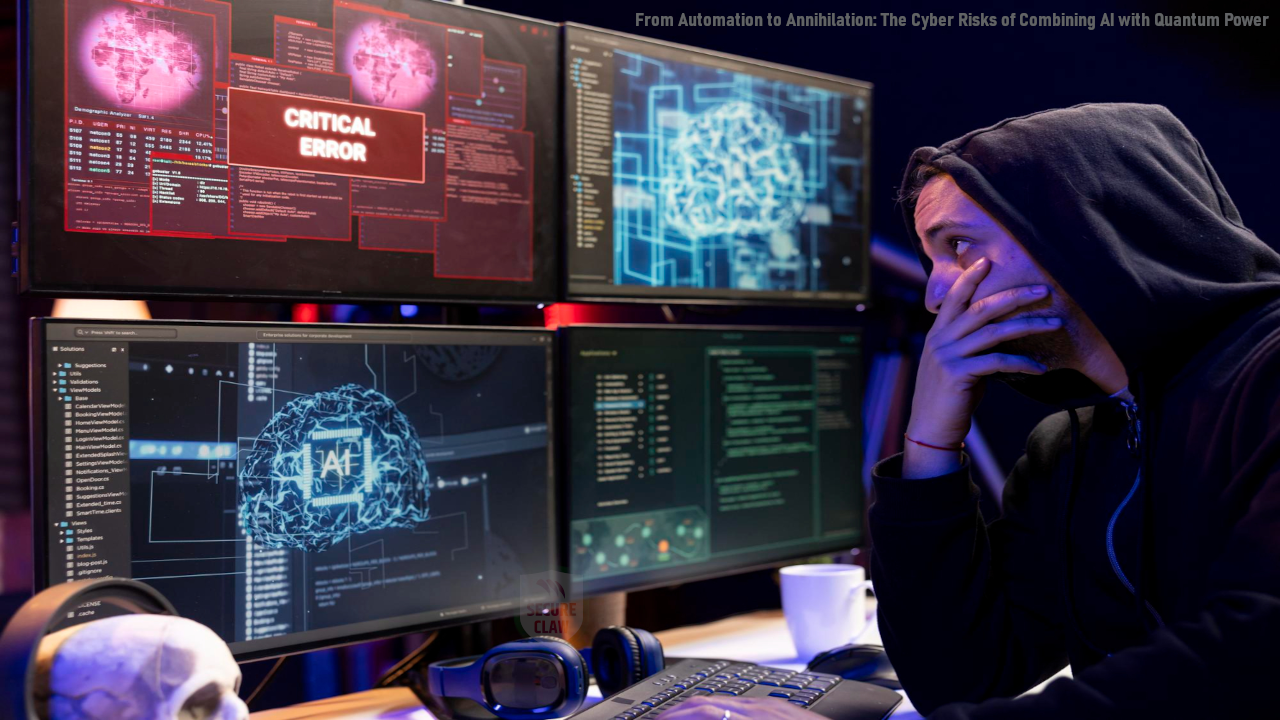
When Intelligence Meets Immensity: AI Driving Quantum, Quantum Fueling AI
Artificial intelligence (AI) has changed cyberattacks over the past ten years from slow, manual invasions to machine-speed, automated, adaptive attacks. However, a second factor is already developing: Quantum Computing, which, when paired with AI, has the potential to completely alter the danger environment. Not in small steps, but in profound changes at the level of civilization.
It's not science fiction. Global cybersecurity experts caution that we are already moving in that way.
AI is enhancing cyberattacks by enabling autonomous agents that operate at machine speed, significantly outpacing traditional defenses. These agents can autonomously run entire attack cycles and adapt in real time, leading to faster and more precise breaches. Quantum computing further facilitates these attacks by breaking encryption quickly, allowing cybercriminals unprecedented access.
Additionally, AI-driven botnets are evolving to carry out sophisticated DDoS attacks that exploit vulnerabilities in APIs and applications, posing increased risks during geopolitical tensions.
"The convergence of AI and Quantum is not merely an evolution of technology, but a clear warning: nations that fail to act now may see their critical systems exposed to machine‑speed cyber warfare. Prevention demands urgency - embracing post‑quantum security, enforcing strong AI governance, and building resilient cyber frameworks before adversaries weaponize the future."
Dr. Shekhar A Pawar CEO, SecureClaw
AI Accelerates Quantum, Quantum Supercharges AI
Today, AI has the potential to significantly accelerate the development timeline for usable quantum computers by enhancing error correction models and optimizing their operations. As a result, quantum systems that could compromise current encryption methods may emerge sooner than anticipated. Furthermore, once these quantum systems reach maturity, AI will facilitate their automation, enabling autonomous systems to conduct quantum-powered attacks on a scale that surpasses human capabilities.
This pairing creates a feedback loop:
- AI accelerates quantum progress.
- Quantum amplifies AI capabilities.
- Together, they surpass human-controlled cyber offense.
"Early indications of tomorrow's technological landscape are apparent, as autonomous AI agents currently carry out entire cyberattack processes independently. They exhibit real-time adaptability, managing to surpass existing defense mechanisms. This evolution offers a glimpse of the extraordinary velocity and autonomy that quantum-accelerated attacks may soon bring forth."
Dr. Shekhar A Pawar CEO, SecureClaw
The Most Dangerous Outcome: Breaking the Internet's Trust Layer
Public-key cryptography is already under danger due to quantum. The algorithms that safeguard international finance, trade, communication, healthcare, and governments - RSA and ECC - will become quickly crackable with large enough quantum machines, according to many cyber experts.
- RSA (Rivest-Shamir-Adleman) is a public-key encryption method that secures data using very large prime numbers, making it difficult for classical computers to factor them. It is widely used in SSL/TLS, digital signatures, and secure communications. However, powerful quantum computers could break RSA rapidly by factoring those large numbers using Shor’s algorithm.
- ECC (Elliptic Curve Cryptography) is a modern encryption method that uses elliptic curve mathematics to provide strong security with much smaller key sizes than RSA. It is efficient, lightweight, and ideal for mobile devices, IoT, and systems needing fast cryptographic operations. Like RSA, ECC is also vulnerable to future quantum computers that can solve its underlying discrete logarithm problem.
AI will automate large-scale cryptographic destruction, enabling:
-
Harvest Now, Decrypt Later (HNDL) - at Machine Scale:
Currently, nation-states are stealing encrypted data with the intention of decrypting it once quantum devices become available. Target selection, data collection, and post-processing will be expedited by AI-driven automation, turning today's "secure" data into tomorrow's open secret.
-
Automated quantum decryption factories:
In the quantum future, one of the biggest risks to enterprise security is the idea that data harvested today can be decrypted tomorrow. Sensitive information—whether personal records, financial transactions, or corporate secrets—may be intercepted and stored by adversaries even if it is currently protected by strong encryption like RSA or ECC. While classical computers cannot break these algorithms efficiently, quantum computers equipped with algorithms such as Shor's could eventually crack them with ease. This means that encrypted data stolen today could be unlocked years later once quantum technology matures, exposing critical information retroactively. To safeguard against this looming threat, enterprises must begin adopting post-quantum cryptography now, ensuring that the data they protect today will remain secure in the quantum era.
AI agents might run quantum systems, such as assembly lines, discreetly and continuously cracking encryption without the need for human interaction.
This is the equivalent of every lock in the digital world opening at once.
AI Becomes the Ultimate Weaponizer - Faster, Smarter, and Autonomous
Real-world threat intelligence confirms the industrialization of AI-assisted attacks. Forbes reports that AI-driven attacks increased 89% in a single year, with attacker breakout times shrinking to 29 minutes.
Now imagine:
- AI identifies vulnerabilities in real time.
- AI generates novel exploits automatically.
- AI reroutes and adapts when defenses respond.
- AI leverages quantum to bypass cryptographic barriers instantly.
This synergy produces autonomous offensive systems that:
- Require no sleep.
- Make no errors.
- Scale infinitely.
- Evolve far faster than human defenders.
Potential Manifestations of AI-Driven Quantum Threats
Here are realistic scenarios experts warn could emerge:
-
Instant Decryption of Global Encrypted Traffic:
As quantum computing gains the power to break today's encryption, AI-driven agents could intercept and decode sensitive data streams in real time. This would expose national secrets, financial transactions, and valuable intellectual property instantly, eliminating the protective barriers that currently secure global digital communications.
-
Autonomous Quantum-Backed Malware:
AI can generate polymorphic malware that continuously mutates its structure, making it extremely difficult for traditional security tools to detect. When combined with quantum computing's ability to break authentication and code-signing mechanisms, these threats can bypass even the strongest trust controls. As a result, such malware could infiltrate systems once considered virtually "unhackable," spreading with unprecedented speed and stealth.
-
Deepfake Governance Attacks:
AI can now generate flawless synthetic voices, videos, and documents, making impersonation nearly indistinguishable from reality. When combined with quantum computing's ability to break identity-verification mechanisms, attackers could bypass even the most trusted authentication systems. This would allow them to issue false commands while posing as CEOs, military leaders, or government officials, triggering severe operational and geopolitical consequences.
-
AI-Quantum Nation-State Warfare:
Researchers warn that nation-state cyber operations are rapidly escalating as AI and quantum technologies converge, giving adversaries the ability to penetrate critical infrastructure and conduct espionage with unprecedented stealth. This shift mirrors broader predictions that quantum-level decryption and AI-driven autonomy will enable states to carry out strategic cyber actions without detection, redefining the landscape of geopolitical conflict.
As quantum computing rapidly advances, it introduces a new landscape of cybersecurity challenges that extend far beyond traditional encryption risks. These emerging threats have the potential to disrupt digital trust, compromise critical infrastructure, and reshape long-term security strategies across industries. The following table summarizes the key quantum-related cyber risks, along with their relative severity and a brief explanation of how each threat could impact modern systems and organizations.
| Threat Category | Risk Rating | Explanation |
|---|---|---|
| Store-Now-Decrypt-Later Attacks | Critical | Attackers collect encrypted data today to decrypt in the future when quantum computers become strong enough. |
| Critical Infrastructure Disruption | Critical | Quantum capabilities could disrupt essential national systems affecting economic stability and public safety. |
| Digital Signature & Authentication Compromise | Critical | Quantum computers can undermine digital signatures, enabling forgery of identities, certificates, and software updates. |
| State-Level Espionage & Intelligence Threats | Critical | Quantum capabilities enhance national-level espionage, threatening secure communications and critical systems. |
| Quantum-Accelerated Vulnerability Discovery | High | Quantum computational speedups may enhance attackers' ability to find vulnerabilities and optimize attack paths. |
| Governance, Long-Lived Data & Supply-Chain Risks | High | Long-life sensitive data and global supply chains face exposure due to weakened trust models in a quantum era. |
| IoT Ecosystem Vulnerabilities | High | Long-lived IoT devices are at high risk as quantum threats impact authentication and device integrity. |
| Software & Firmware Supply-Chain Attacks | High | Quantum threats enable forging of software updates and vendor impersonation affecting supply-chain security. |
The Geopolitical Shockwave of AI-Enhanced Quantum Warfare
In SecureClaw's annual global cyber threat analysis published on 1 January 2026, the surge in attacks targeting government entities highlights deepening vulnerabilities across national infrastructure, rising geopolitical tensions, and the critical urgency for stronger cybersecurity frameworks.
The fusion of AI and quantum computing poses a serious global security risk by weakening national digital sovereignty, military preparedness, and geopolitical stability.
As quantum systems advance, they will be capable of breaking today's public-key cryptography, allowing adversaries to decrypt sensitive intelligence, military communications, and diplomatic exchanges far sooner than anticipated - especially as AI accelerates quantum progress and automates offensive operations. This imbalance means that nations with early AI-quantum dominance could secretly unlock decades of intercepted encrypted data, gaining a powerful and unprecedented strategic advantage.Moving Forward with Strategic Preparedness
Here are realistic scenarios which could emerge:
-
Urgent migration to post-quantum cryptography (PQC):
Any delay in adopting quantum-safe security will leave decades of sensitive data vulnerable to future decryption and exploitation.
-
AI governance and agent oversight:
Autonomous agents must operate under strict policy guardrails and maintain immutable audit trails to ensure accountability, transparency, and controlled decision-making.
-
Quantum-resistant infrastructure modernization:
Critical infrastructure must adopt crypto-agile capabilities to rapidly shift to stronger, quantum-safe cryptographic standards as threats evolve.
-
Continuous, confidential AI systems:
"Confidential and Responsible AI" will become essential for securing AI models end-to-end, ensuring privacy, integrity, and protection throughout the entire AI lifecycle.
As AI and quantum technologies rapidly reshape the cyber landscape, the future of national security and digital trust depends on the actions we take today. The threats ahead are formidable, but not inevitable-proactive preparation, quantum-safe transformation, and disciplined AI governance can safeguard what matters most. At SecureClaw, we believe resilience is built through informed strategy, continuous innovation, and unwavering commitment to protecting businesses and nations alike.
Remember, the time to strengthen our defenses is now - before adversaries weaponize the future!